
01Introduction
Bead mills are the standard fine-grinding machine in modern paint and colorant plants. They give high throughput, closed operation and good temperature control.
Choosing the wrong beads or chamber size is the most common reason for poor results, so this page walks through the decisions.
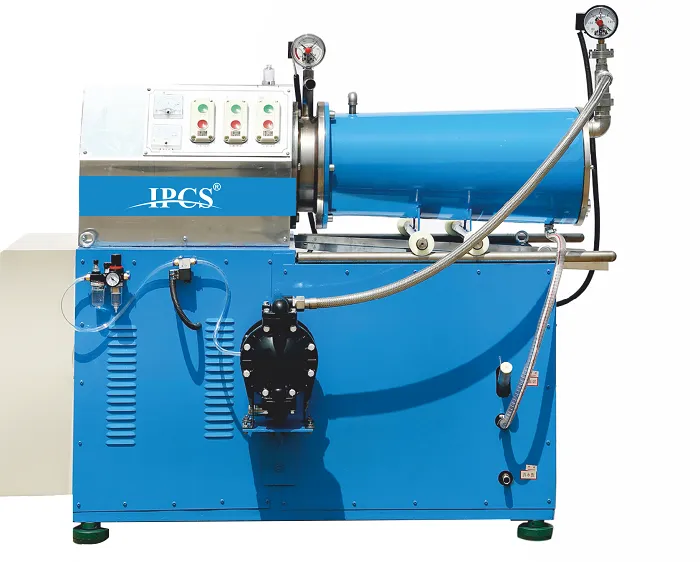
02What Is Horizontal Bead Mill?
The chamber is a cylinder, usually jacketed for cooling, partly filled with grinding beads. A rotor with discs or pins moves the beads, creating shear and impact. Paste is pumped through, and beads are kept inside by a separation screen or gap.
Beads are typically ceramic such as zirconium silicate or zirconia, or glass for gentler duties. Bead size is chosen against the target fineness.
03Working Principle
Energy is transferred from the rotor to the beads and from the beads to pigment agglomerates. Smaller beads give finer grind but lower flow; larger beads give higher throughput.
- Pre-dispersed paste is pumped through the chamber
- Beads in motion crush and shear agglomerates
- Cooling jacket removes heat
- Separator keeps beads in the mill
- Passes or recirculation reach the final fineness
04Applications
- Solvent and water-based enamels
- Colorants and tinting pastes
- Premium emulsion pigment pastes
- Inks and coatings
- Industrial paints needing high gloss
05Types & Configurations
| Type | Features | Suits |
|---|---|---|
| Disc type | Flat discs on shaft | General paint grinding |
| Pin type | Pins on shaft | Fine grinding of pastes |
| Annular gap type | Narrow gap grinding | Nano and fine pigments |
| Small lab mill | Compact chamber | Trials and small batches |
| Flameproof bead mill | Explosion-proof electricals | Solvent systems |
06Key Selection Factors
| Factor | What to decide | Guidance |
|---|---|---|
| Chamber volume | Throughput | Match to batch size and passes |
| Bead material and size | Grind level | Often 0.8 to 2 mm for paints, smaller for fine colorants |
| Bead fill | Efficiency | Commonly 70 to 85 percent of chamber for horizontal mills |
| Cooling | Paste temperature | Water jacket and chiller if needed |
| Seal type | Reliability | Mechanical seals for solvents |
| Pump and feed | Flow control | Positive displacement or suitable pump |
07Where It Fits in the Process
- Premix pasteIn a disperser at correct viscosity.
- Pump to millControlled flow.
- GrindBeads work the paste.
- Check finenessHegman or microscope.
- Recirculate or pass againUntil target.
- CollectIn let-down tank.
08Installation & Utility Requirements
- Level foundation
- Cooling water supply
- Pump and piping
- Flameproof wiring if solvents
- Space for bead replacement
09Safety & Operating Practice
- Pressure relief on the chamber
- Guarding and lock-out
- Cooling and temperature monitoring
- Flameproof equipment for solvents
10Maintenance & Common Problems
| Problem | Likely cause | Fix |
|---|---|---|
| Overheating | Low flow or insufficient cooling | Increase cooling, lower speed |
| Bead wear and contamination | Low-quality beads | Use quality beads, check wear |
| Poor fineness | Wrong bead size, low fill | Adjust beads and fill |
| Screen blocking | Coarse particles | Pre-screen paste |
| Seal leakage | Seal wear | Replace seal, check alignment |
11How IPCS Supports Machinery Selection
- Mill and bead selection for your pigment range
- Cooling and pump design
- Operator training for grind control
Machine details are indicative and are finalised against your product, batch size and site during quotation.
12Frequently Asked Questions
Do I need a bead mill for emulsion paint?
Not for most matt grades. It helps premium finish and colour-rich products.
Which beads should I use?
Zirconium silicate or zirconia ceramic beads in sizes matched to target fineness; smaller for finer grind.
How many passes are needed?
Depends on pigment and target, typically one to several.
Can one mill handle all colours?
Yes with cleaning; dedicated mills for dark and light colours reduce contamination.
What is the difference between a bead mill and a basket mill?
A bead mill is a closed chamber with pump feed; a basket mill is a basket immersed in an open tank.