
01Introduction
Most paint plants start with a disperser because it prepares nearly every batch. It handles mixing of water, additives and pigments, makes the pigment paste, and blends resin and additives in the let-down stage.
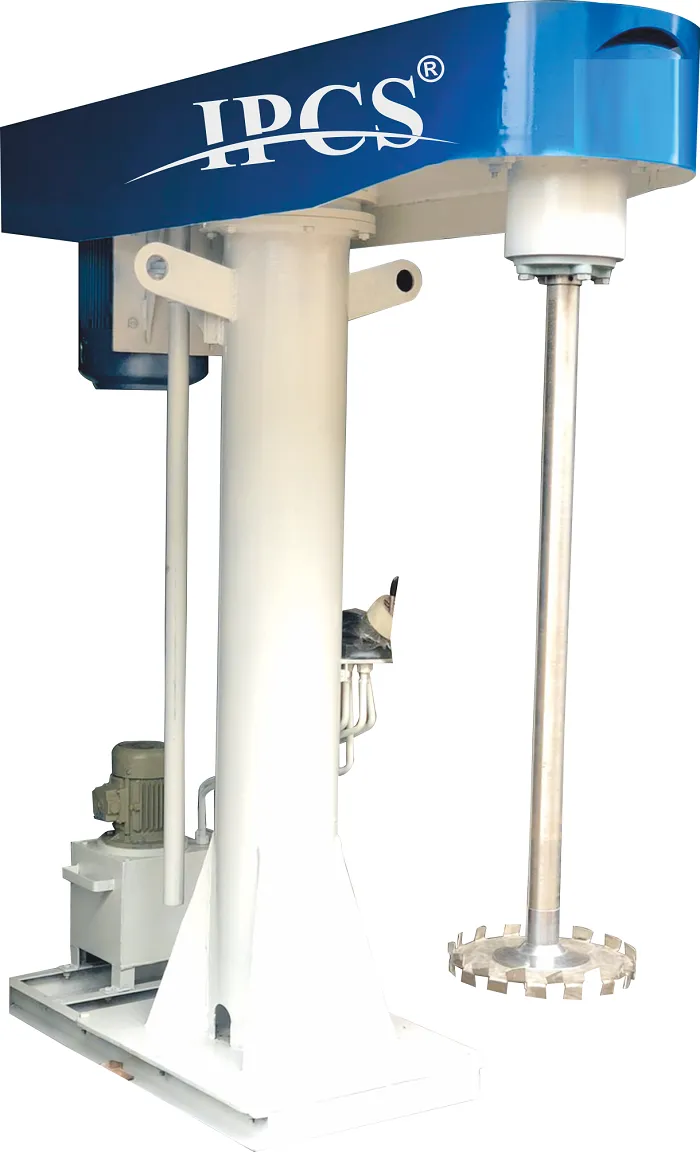
02What Is a High Speed Disperser?
An HSD has a motor and gearbox or belt drive, a vertical shaft, a Cowles-type disc, a column with a lift, and a tank or vessel. The lift raises the disc out of the tank for cleaning and sampling. Tanks can be fixed or movable, so one disperser can serve several tanks.
03Working Principle
The disc rotates and flings liquid outwards, so the batch moves in a doughnut-shaped flow pattern. The vortex pulls powder from the surface into the liquid. Near the disc edge the shear is highest, which breaks pigment agglomerates and wets each particle.
- Shear is highest at the disc edge, so disc size and speed set dispersion quality.
- The flow pattern must stay laminar enough to keep the batch moving without sucking in air.
- Higher viscosity needs a lower disc position and more power, and too thick a batch stops flowing.
04Applications
- Emulsion paint, primer and distemper mixing
- Pigment paste and colorant premix before milling
- Putty and texture slurry preparation
- Let-down of resin, additives and thickeners
- Dispersion of fillers in enamels (with flameproof design for solvent systems)
05Types & Configurations
| Type | Features | Suits |
|---|---|---|
| Fixed-speed, manual lift | Simple, lower cost | Small batches, few products |
| Variable speed (VFD), hydraulic lift | Speed set per product, easy tank change | Most commercial plants |
| Twin-tank, movable tank | One disperser serves two tanks | Plants that want faster batch turnover |
| Flameproof design | Safe motor and electrics | Solvent-based paints and enamels |
For thicker, higher-solids products see twin shaft disperser.
06Key Selection Factors
| Factor | What to decide | Rule of thumb |
|---|---|---|
| Batch size | Working volume per batch | Tank holds the batch with room for the vortex |
| Disc diameter | Shear and flow | Often about one third of tank diameter, tuned in trials |
| Tip speed | Dispersion energy | Commonly about 18 to 25 m/s for dispersion |
| Motor power | Viscosity and solids | Indicative: small batches few hp, one tonne batches tens of hp |
| Drive | Control of speed | VFD for different products |
| Material of contact parts | Corrosion and product purity | Stainless steel for water-based and colour-critical products |
| Safety | Solvent use | Flameproof motor and earthing for solvent paints |
07Where It Fits in the Process
- Charge liquidsWater, dispersant and additives go in first.
- Add pigments and fillersAdd slowly into the vortex at controlled speed.
- DisperseRun at higher speed until the paste is smooth.
- Let downReduce speed and add resin and additives.
- Adjust and checkTest viscosity, pH and fineness.
- Filter and fillFilter, then fill containers.
08Installation & Utility Requirements
- Level, strong floor with room for the lift column and tank movement
- Three-phase power with correct earthing; flameproof electricals for solvents
- Ventilation and spill containment
- Overhead clearance for the raised disc
- Water and compressed air only where the model needs them
09Maintenance & Common Problems
| Problem | Likely cause | Fix |
|---|---|---|
| Air bubbles in the batch | Disc too high or speed too high | Lower speed or disc position |
| Poor dispersion | Disc too small, speed low, batch too thick | Increase disc size or speed, adjust solids |
| Dead zones at the wall | Disc too small for the tank | Resize disc, use a tank scraper where needed |
| Overheating | Long runs, high solids | Cooling jacket or shorter cycle |
| Seal or gearbox leak | Wear or contamination | Planned maintenance, correct lubricant |
10IPCS Technical Support
- Disperser and tank sizing against your product list and daily output
- Complete line planning with mills, tanks, filtration and filling
- Formula trials and operator training
- Commissioning support and spares guidance
Machine details are indicative and are finalised against your product during quotation.
11Frequently Asked Questions
What is a high speed disperser used for?
A high speed disperser mixes pigment, filler and liquids into a uniform paste or paint. It is the main mixing machine in emulsion paint plants and the first step before a bead mill in finer products.
How does a high speed disperser work?
A toothed Cowles disc spins at high speed in the batch. The disc creates a vortex that pulls solids down and a high-shear zone at its edge that wets and breaks up pigment lumps.
What speed should a disperser run at?
Disc tip speed commonly falls in the range of about 18 to 25 metres per second for dispersion, and lower for let-down. A variable frequency drive lets you set speed by product and viscosity.
What size disc should I use?
A common starting point is a disc diameter of about one third of the tank diameter, with the disc placed about one disc diameter above the tank bottom. Final settings come from trials with your product.
Can a high speed disperser replace a bead mill?
No. It disperses and mixes but does not grind to a very fine particle size. Premium finishes, colorants and high-gloss products need a horizontal bead mill after dispersion.
Is a flameproof motor needed?
Yes for solvent-based paints. Solvent vapour needs flameproof motors, earthing and safe electrical design. Water-based paint can use standard industrial motors.
How much motor power does a disperser need?
Power depends on batch size, viscosity and solids. Indicative starting points are a few horsepower for small batches and tens of horsepower for batches of about one tonne. We size it against your product.
How can IPCS help me choose the right disperser?
IPCS matches disperser size, motor, speed range, lift type and tank to your product list and daily output, and plans the rest of the line around it. See paint plant setup.