
01Introduction
Many new plants start with a small putty line because it is compact, quick to install and sells readily. The machine is simple but needs good dust control.
This page covers what the machine includes and how to size it.
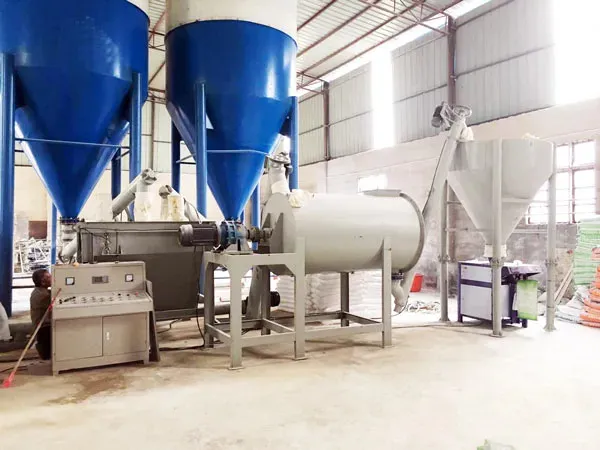
02What Is Wall Putty Manufacturing Machine?
A common layout has a ribbon blender, a screw conveyor for loading, a storage hopper or silo, a screw feeder to a bagging machine and a dust collector. The mixer discharges into the hopper through a valve. Hoppers allow continuous bagging while the next batch is mixing.
For acrylic putty paste, a different machine is used: heavy-duty mixers such as a sigma mixer.
03Working Principle
Powders are charged, blended in the ribbon mixer, discharged to a hopper and bagged. Screw conveyors reduce manual handling.
- Ribbon blender for uniform mixing
- Screw conveyor for transfer
- Silo or hopper for buffering
- Bagging machine for fixed weights
04Applications
- White cement putty
- Skim coat and plaster in small plants
- Cement paint
- Tile adhesive (with proper mixer settings)
05Types & Configurations
| Type | Features | Suits |
|---|---|---|
| Manual charge, manual pack | Lowest cost | Start-ups |
| Screw conveyor and silo | Reduced handling | Growing plants |
| Automatic weighing and packing | Accurate and fast | Higher output |
| Compact plant on a skid | Quick installation | Small shops |
06Key Selection Factors
| Factor | What to decide | Guidance |
|---|---|---|
| Output per day | Tonnes or bags | Set mixer size and shift plan |
| Batch size | Kg per batch | Match to mixing time |
| Packing method | Manual, semi, automatic | Labour cost and accuracy |
| Dust collection | Capacity | Connect at hopper, mixer and bagging |
| Building height | For silo and conveyor | Plan before ordering |
| Product range | Other powders | Allow cleaning and flexibility |
07Where It Fits in the Process
- Charge raw materialsVia conveyor or manually.
- MixRibbon blender.
- Discharge to hopper
- BagFixed weight.
- Seal and label
- StoreDry and off the floor.
08Installation & Utility Requirements
- Level concrete floor
- Dust-tight cover and collector
- Moisture-proof store
- Power supply and earthing
09Safety & Operating Practice
- Interlocked covers
- Lock-out
- PPE for dust
- Fire extinguishers
10Maintenance & Common Problems
| Problem | Likely cause | Fix |
|---|---|---|
| Poor mixing | Wrong fill or time | Adjust |
| Dust leakage | Poor seals | Seal and extraction |
| Blocked screw | Moist powder | Dry materials |
| Weight variation | Feeder variation | Calibrate |
| Caking in bags | Moisture | Better packaging |
11How IPCS Supports Machinery Selection
- Sizing and layout
- Dust collection and packing selection
- Formulation and testing
Machine details are indicative and are finalised against your product, batch size and site during quotation.
12Frequently Asked Questions
How much space does a putty plant need?
A compact line can fit in a few hundred square metres including storage; plan more for growth.
Can the same machine make tile adhesive?
Yes, with cleaning and separate formulas.
Do I need a silo?
It helps continuous bagging but is optional in a starter plant.
Is acrylic putty made on this machine?
No; it needs a paste mixer.
What output can I expect?
Depends on mixer size and shifts; the quote states capacity.