
01Introduction
Pug mills are workhorse mixers in ceramics, brick and mortar industries. In paint and construction chemical plants they appear in wet mortar, stucco and conditioning lines.
They trade precision for toughness and continuous operation.
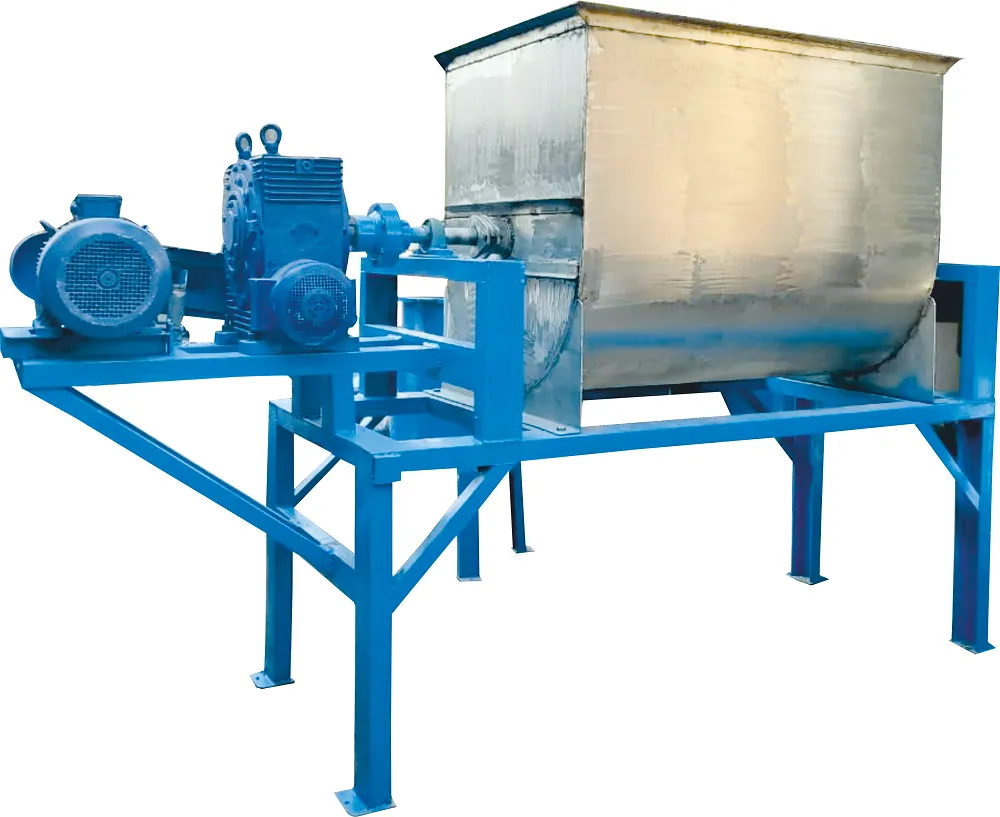
02What Is Pug Mill?
A pug mill consists of a horizontal trough with a feed hopper, one or two paddle shafts, a drive and a discharge at the end. Paddles are set at angles so that they mix and convey the material. Water or additives can be sprayed in along the trough.
Twin-shaft types give better mixing and are the usual choice for mortars.
03Working Principle
Paddles rotate in the trough, lifting, folding and moving the mix toward the discharge. Residence time is set by speed, paddle angle and trough length.
- Continuous feed and discharge
- Paddle angle controls retention
- Water injection for wet mixes
- Wear-resistant paddles
04Applications
- Wet masonry and plaster mortar
- Clay, stucco and conditioning mixes
- Dust control moisturising of powders
- Putty-type pastes and fillers (suitable models)
05Types & Configurations
| Type | Features | Suits |
|---|---|---|
| Single-shaft pug mill | Simple and economical | Light duty |
| Twin-shaft pug mill | Better mixing | Mortars |
| Pug mill with water spray | Moisture control | Wet mortar |
| Heavy-duty pug mill | High wear resistance | Abrasive materials |
06Key Selection Factors
| Factor | What to decide | Guidance |
|---|---|---|
| Capacity | Tonnes per hour | Set by throughput target |
| Number of shafts | Mixing quality | Twin for mortars |
| Paddle material | Wear life | Hardened steel or liners |
| Trough length | Residence time | Longer for better mix |
| Drive power | Torque | Matched to material density |
| Dosing | Water and additive injection | Spray bars |
07Where It Fits in the Process
- FeedDry and damp materials into hopper.
- Add liquidsSpray or inject.
- Mix and conveyPaddles move material.
- DischargeAt the end of the trough.
- Check qualityConsistency.
- CleanWash out.
08Installation & Utility Requirements
- Strong frame
- Water supply for wet types
- Discharge conveyor or bin
- Dust control for dry feeds
09Safety & Operating Practice
- Guard the open trough
- Lock-out for cleaning
- Interlocked covers
- Noise and dust control
10Maintenance & Common Problems
| Problem | Likely cause | Fix |
|---|---|---|
| Poor mixing | Short trough or wrong paddles | Adjust paddle angle or speed |
| Wear of paddles | Abrasive materials | Hardened paddles, regular checks |
| Blockage | Overfeeding | Control feed rate |
| Dust | Dry material | Water spray, enclosures |
| Leakage at shaft seals | Wear | Maintain seals |
11How IPCS Supports Machinery Selection
- Application review to confirm if a pug mill is suitable
- Sizing and options
Machine details are indicative and are finalised against your product, batch size and site during quotation.
12Frequently Asked Questions
What is a pug mill used for?
For continuous mixing of wet or damp materials, such as mortar and clay.
Can a pug mill blend dry powders?
It is not the best choice for precise dry blending; use a ribbon or paddle mixer.
How does it differ from a ribbon blender?
A pug mill is a trough with paddles and suits wet mixes and continuous work; a ribbon blender suits dry blends.
Is it suitable for putty?
For some putty-type mixes; test.
How is it cleaned?
Wash down with water or solvent as appropriate.